Friday, 30 November 2007

Arrived

late harvest

So much to see and tell.

Let's start with one of my biggest sadnesses while I was away. The little vegetable plot that we planted up at the end of July had been abandoned for three months and we were sure that it would have disappeared under a mess of weeds and rotting vegetation, stomped to a pulp by rampaging deer.

It's true, the deer had finally overcome their distaste for my string boundaries and chomped the tops off the carrots and beetroot making quite a mess of the place with their pointy little feet but the actual roots were fine and big, the cabbages, dill and oca protected by a wire cage absolutely fine and the winter radishes and peas, also under wire protection are slightly past their best but still growing, still trying to produce pods and with still enough tender roots to make salads and pickles. We were too late with the haricots and the spring onions don't seem to have survived but I am hugely relieved.

In the back garden plot the pumpkins had succumbed to frosts and the Moscata fruits were destroyed by the cold, but because the grass was so long some of the Rouge Vif d'Etampes had been buffered from the chill and are still good. I don't think they'll keep very long after this treatment but at least we'll have enough for a few meals.

We're proudest of the cabbages. Although we've been growing our own for years, all leafy brassicas have been a trial for us, martyrs to caterpillars and swamped by slugs. This year, by luck or judgement, with the help of the wire cloche the butterflies have been kept at bay and the cabbages have grown quickly enough to leave the slugs behind.

Another comforting discovery is that the oca has managed, despite my cruel and careless treatment of it earlier in the year, to make two good sized plants that will provide all the seed tubers we need for a proper planting next year. Even more gratifying is that both varieties have come through - I really thought I'd lost the slightly more tender maroon coloured sort but now stocks of both are in equal proportions.

It's so good to be back.

Wednesday, 28 November 2007

Going Home

homestead

I think, I hope, I'll be back at the homestead this time tomorrow. It's been such a long wait, for many good reasons it's true, but I don't think that until now I realised quite how much my heart has been breaking.

Next time, in France.

Tuesday, 6 November 2007

Medlar Jelly again

I've updated the original medlar jelly entry posted last year with this year's results. Just in case you were wondering where it had got to.

The other medlar recipe on the blog is here.

Tuesday, 30 October 2007

Jam

At the weekend while we were taking medlars in before the wind blew them all to kingdom come the kind neighbours whose chaenomeles I plundered a few weeks ago stuck their heads over the boundary and offered me some of the quinces from their side of the fence. Slightly squirming with embarrassment I gladly accepted - I couldn't reach any more from my side but I could see the burgeoning crop and it was tantalising. In return we gave them a few medlars and a jar of last year's jelly. I hope it was o.k., it looked a little cloudy after a year in store.

medlar

Anyway, this meant as well as bowl of medlars to process I also have a bag of quince. How fortunate then that I found a Dutch recipe on the web for a Medlar and Japanese Quince Jam.

I've modified it a bit, there is no need to add extra pectin to these fruit, they set perfectly well without it and I slightly increased the proportion of Japanese quince to Medlar.

To make about four jars of jam take a kilo of medlars and half a kilo of Japanese quince. The medlar fruit should be as ripe as possible but not mouldy or smelly rotten and the quinces as golden and fragrant as the weather will allow.

Wash the fruit well and chop it up, cores and all removing any bruised parts. The seeds fall out of the quinces quite easily so take those out but don't worry about the medlars.

Place the prepared fruit in your large pan and barely cover with water. Bring to a gently simmer and let it all cook until the fruit is completely mushy and disintegrated. Mash it a bit with a potato masher to make sure.

If you have a food mill put the fruit through it to remove the skins, seeds and hard bits. My food mill is in France so I had to rub the pulp through a nylon sieve to get all the lovely fruit and its juices away from the rubbish. You should be left with just over 2 pints of thick perfumed pureed medlars and quince.

Put the puree back in the clean pan and add a pound of sugar to each pint of puree (that's about 800g to the litre). Stir it over a gentle heat until the sugar is completely dissolved then skim off the scum that rises and boil hard for 5 minutes. Check for a set by putting a little on a cold plate, letting it cool and seeing if wrinkles form as you push it. It should reach this setting point quickly and easily so don't overboil it.

Pot up into clean sterilised jars and seal immediately.

We were really surprised when first tasting it just how closely the flavour resembled apples. Is there a market for faux apple jam? Of course not, but for something as exotic as Quince and Medlar jam there are bound to be takers.

Saturday, 27 October 2007

PoMo part 2

The second part of the answer to life and everything is about cats.

bagheera

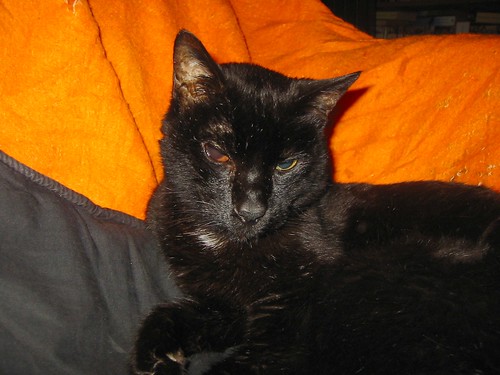
This is my cat. We've been together for over fifteen years now and he's reaching the end of an eventful life. Before him, I've had a lot of other cats but I'm no expert. Even so, I feel qualified to record some salient facts about cat maintenance here for the edification of others.

Are Japanese cats valuable?

Too right they are. All cats are valuable and those belonging to the Japanese are no exception, but I expect the query was poorly formed. All pedigree cats are expensive and the most significantly recognised form of Japanese cat is the Japanese Bobtail. If you are planning to abuse a Japanese citizen by abducting their cat, the Bobtail is your mark.

Cat sanctuary in Normandy?

Let me give you a few of my feelings about the treatment of cats in France, and in particular Normandy. It's bloody terrible and it's no good shrugging your shoulders in a particularly British way and blaming it all on the French because this is a human failing, demonstrated with equal facility by all races of apes. We take these creatures in, use them for our own emotional support and then, when the going gets tough palm them off on others, crying huge crocodile tears while we do it. There are cat sanctuaries in Normandy but if I tell you where they are it's only so that you can help them. If I find you've been casting off your obligations by callously abandoning members of your family I will track you down and cut off your genitals. And I do know where you live.

Cats and [name your poison]?

There are a lot of queries about cats and particular foodstuffs, cats and paint fumes, cats and almost any sort of ingestible material.

I'm here to tell you that cats take fancies to all sort of odd things. Usually it's just because it tastes nice. I've had cats who've chased olive stones all over the carpet, as far as I could tell because they liked the salt. Sometimes it's because they're naughty, a couple of kittens of my acquaintance could never stop themselves from chewing open the bread bags in case there was cheese inside. The old cat pictured above likes to lick up the tomato sauce from a plate of pasta and will take a (one) drop of whisky from my little finger once in a while, because he can.

If the habit becomes a nuisance or the substance in question is too bizarre then there is a name for the condition. Pica which is the voluntary ingestion of non-edible materials accounts for approximately 2.5% of abnormal behaviors in the domestic cat. There is no clear explanation for cases of pica and they are usually attributed to dietary deficiencies or mental disorder.

Wool-sucking isn't the same thing as pica because it is a compulsive, misdirected form of nursing behavior. Read more about this here.

Significant poisons of cats include lilies and their pollen, antifreeze and aspirin. Additionally there are many other toxins that you should try to keep from your cat e.g.; alcoholic beverages, avocado, chocolate (all forms), coffee (all forms), macadamia nuts, onions, onion powder, garlic, citronella candles, insecticides, medications for humans or other animals, mothballs and batteries. A fuller list can be found here but basically if it would harm your toddler it will harm your pet.

Things which are NOT considered harmful include; water-based paints, toilet bowl water, silica gel, poinsettia, cat litter, glue traps and glow jewelry so get some perspective people, and check out other harmless possibilities for your pets here.

PoMo part 2

The second part of the answer to life and everything is about cats.

bagheera

This is my cat. We've been together for over fifteen years now and he's reaching the end of an eventful life. Before him, I've had a lot of other cats but I'm no expert. Even so, I feel qualified to record some salient facts about cat maintenance here for the edification of others.

Are Japanese cats valuable?

Too right they are. All cats are valuable and those belonging to the Japanese are no exception, but I expect the query was poorly formed. All pedigree cats are expensive and the most significantly recognised form of Japanese cat is the Japanese Bobtail. If you are planning to abuse a Japanese citizen by abducting their cat, the Bobtail is your mark.

Cat sanctuary in Normandy?

Let me give you a few of my feelings about the treatment of cats in France, and in particular Normandy. It's bloody terrible and it's no good shrugging your shoulders in a particularly British way and blaming it all on the French because this is a human failing, demonstrated with equal facility by all races of apes. We take these creatures in, use them for our own emotional support and then, when the going gets tough palm them off on others, crying huge crocodile tears while we do it. There are cat sanctuaries in Normandy but if I tell you where they are it's only so that you can help them. If I find you've been casting off your obligations by callously abandoning members of your family I will track you down and cut off your genitals. And I do know where you live.

Cats and [name your poison]?

There a lot of queries about cats and particular foodstuffs, cats and paint fumes, cats and almost any sort of ingestible material.

I'm here to tell you that cats take fancies to all sort of odd things. Usually it's just because it tastes nice, I've had cats who've chased olive stones all over the carpet, as far as I could tell because they liked the salt. Sometimes it's because they're naughty. A couple of kittens of my acquaintance could never stop themselves from chewing open the bread bags in case there was cheese inside...

If the habit becomes a nuisance or the substance in question is too bizarre then there is a name for the condition. Pica which is the voluntary ingestion of non-edible materials accounts for approximately 2.5% of abnormal behaviors in the domestic cat. There is no clear explanation for cases of pica and they are usually attributed to dietary deficiencies or mental disorder.

Wool-sucking isn't the same thing as pice because it is a compulsive, misdirected form of nursing behavior. Read more about this here.

Significant poisons of cats include lilies and their pollen, antifreeze and aspirin. Additionally there are many other toxins that you should try to keep from your cat like; Alcoholic beverages, Avocado, Chocolate (all forms), Coffee (all forms), Macadamia nuts, Onions, onion powder, Garlic, Citronella candles, insecticides, medications for humans or other animals, Mothballs and batteries. A fuller list can be found here but basically if it would harm your toddler it will harm your pet.


Non-toxic Substances for Dogs and Cats
The following substances are considered to be non-toxic, although they may cause mild gastrointestinal upset in some animals:
- Water-based paints
- Toilet bowl water
- Silica gel
- Poinsettia
- Cat litter
- Glue traps
- Glow jewelry

Friday, 26 October 2007

PoMo part 1

Like most bloggers I keep a finger on the pulse of my readership by use of a tracking site. It doesn't give me much information about you, so don't panic, but it does quite often list the search terms that brought you to my blog in the first place.

angel

Apart from one or two very regular readers most of the traffic is from passing trade, people looking for images - the big hornet and the giant puffball are favourites - and recipes for jam and alcoholic beverages. This isn't the sort of place where people searching for new bondage knots or enormous willies are satisfied so the search terms are rarely more exotic than that and that's a good thing, but I have noticed a couple of other trends which I now intend to address because I don't like to think of people washing up here and leaving disappointed.

Firstly the matter of tripe.

It's in the title so it's hardly surprising that it gets a fairly frequent outing but as far as I remember there's nothing here actually about tripe. Until now, when I give you all the lowdown and a small insight into the naming of the blog.

There is the meat tripe. Tripe is usually the lining of a cow's stomach, although pork and sheep's stomachs also fall under the definition. The first cow's stomach gives smooth tripe, the second honeycomb tripe and there is also pocket tripe. Tripe is usually partially prepared by the butcher before further long cooking in an attempt to render it edible. There is a famous French dish called tripes à la mode de Caen, a local speciality to us in Normandy and as well as being on all the restaurant menus it is also available in jars in the supermarket and from the delicatessen stalls. The Spanish tradition with tripe is to make menudo, a sort of tripe soup. Naturally as a vegan I can't recommend you try it but even not as a vegan I know of few who enjoy it although some from the beleaguered North of England may sigh nostalgically when it's mentioned.

Then we have the second meaning of the word tripe which is:
Nonsensical or worthless language, drivel, codswallop or folderol, words which require definitions of their own but you get the general picture.

And that's the sort of tripe of which this blog is composed along with a little colourful imagery designed to nudge the imagination into comparing the intestines of cats with something said animal might have dragged in. The true level of my mind is revealed.

The second most frequent sort of query I shall address another day.